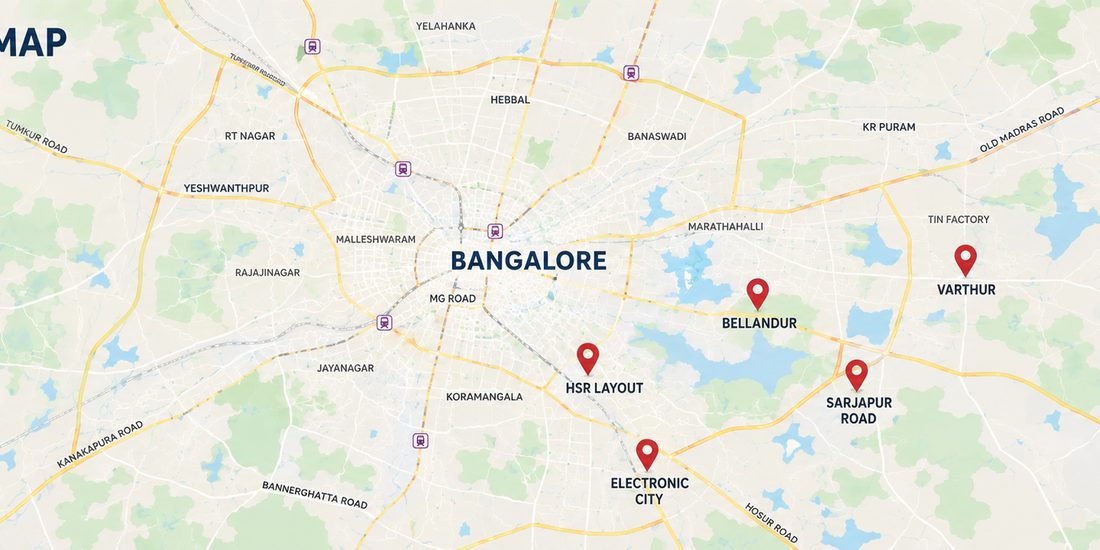
Why South-East Bangalore?
South-East Bangalore — spanning Electronic City, Sarjapur Road, Bellandur, Varthur, and the Whitefield-Gunjur stretch — is home to the largest concentration of technology campuses and IT parks in the city. This employment density creates a structural floor under residential demand that most other corridors simply do not have. When IT hiring picks up, so does the demand for homes within commuting distance.
Current Price Trends (2026)
Prices across South-East Bangalore have appreciated steadily over the past 18–24 months, driven by post-pandemic demand recovery, limited new launches relative to absorption, and the activation of infrastructure projects that were long-pending. Key data points worth understanding:
- Electronic City: 2 BHK apartments in the ₹45–70 lakh range remain available, making this the most affordable employment-proximate corridor in Bangalore. Limited land availability is beginning to constrain new supply.
- Sarjapur Road (inner stretch): Prices for quality 2 BHKs now start at ₹85 lakh and can exceed ₹1.5 crore for premium configurations. Demand from Whitefield and Outer Ring Road employees continues to be strong.
- Bellandur / Varthur: Mid-segment and premium launches are being absorbed quickly. The Bellandur lake rejuvenation and improved BBMP roads have renewed buyer confidence in this micro-market.
- Whitefield–Kadugodi–Varthur–Gunjur: The metro's activation through this corridor has created a measurable price impact. Gunjur, which was considered remote two years ago, is now seeing developer interest as a next-wave affordable option.
Home Loan Interest Rates in 2026
Home loan rates from major banks and NBFCs currently range between 8.5% and 9.5% for salaried borrowers with good credit profiles, following a period of rate adjustments by the RBI. For a ₹70 lakh loan over 20 years, the approximate EMI at 9% is around ₹62,000 per month. While this is not historically low, it is within a range where most IT professionals earning ₹18–25 lakh annually can sustain a loan comfortably, particularly if they are targeting a primary residence rather than speculative investment.
Buyers who have been waiting for rates to drop significantly should be aware: a rate reduction of 0.5% on a ₹70 lakh loan reduces the monthly EMI by approximately ₹2,300 — a relatively modest saving compared to a potential price increase of ₹3–5 lakh if you wait 12 months in a rising market.
Upcoming Infrastructure That Will Impact This Corridor
- Metro Phase 2 (Purple Line Extension): The extension toward Whitefield and Kadugodi is operational. The Yellow Line (RV Road to Bommasandra) will directly serve Electronic City, changing its connectivity profile significantly when complete.
- Peripheral Ring Road (PRR): The PRR will connect Tumkur Road, Bellary Road, and Old Madras Road to Hosur Road, providing a significant bypass for South-East Bangalore commuters. Areas near PRR interchanges are likely to see appreciation once timelines solidify.
- NICE Road extensions and Hosur Road widening have already reduced travel time to Electronic City from HSR Layout and Koramangala.
- Sarjapur–Marathahalli signal-free corridor: Long planned, this is expected to meaningfully ease the congestion that has historically been cited as the main concern for buyers in this micro-market.
Supply vs Demand: What the Numbers Tell Us
South-East Bangalore has historically seen faster absorption than new supply can replace, particularly in the mid-segment (₹60 lakh – ₹1.5 crore range). Most large developers have shifted their launch pipelines away from very affordable inventory (sub-₹60 lakh) because land costs no longer support it, meaning the mid-segment is now carrying most of the demand. This structural gap between what buyers can afford and what developers are building is a key driver of the price floor in this corridor.
The Real Cost of Waiting
Buyers who were "waiting to see" in 2023 found themselves facing prices 12–20% higher by 2025. Waiting involves a real cost that most buyers underestimate: rent paid during the waiting period (often ₹25,000–45,000/month), appreciation on the property price they didn't lock in, and the psychological cost of extended uncertainty. A buyer waiting 18 months before buying in this corridor could easily lose ₹5–8 lakh in combined opportunity cost and price appreciation.
Who Should Buy Now
- Salaried professionals with stable employment near the South-East corridor who have been paying rent for 2+ years
- Families with school-going children who want to settle in an established neighbourhood near good schools
- Buyers in the ₹60 lakh – ₹1.2 crore range who have a 20–30% down payment ready
- NRIs looking for a long-term investment in a fundamentally strong micro-market with high rental demand
Who Should Wait
- Buyers whose income or employment situation is uncertain or in transition
- Those who haven't yet built up a meaningful down payment (at least 20% is advisable)
- Buyers targeting very specific projects or configurations that are not currently available in the market
- Anyone whose primary requirement is a location outside South-East Bangalore — don't let urgency push you into the wrong geography