Why Infrastructure Is the Single Biggest Driver of Real Estate Appreciation
In Bangalore, as in most large cities, the single most reliable predictor of residential price appreciation is not GDP growth or interest rates — it is infrastructure. A metro station, a signal-free corridor, or a ring road that reduces average commute time by 20 minutes has a direct, measurable impact on how buyers and tenants value a location. Understanding where Bangalore's infrastructure pipeline is headed is therefore one of the most useful things an investor or upgrader can do before committing capital.
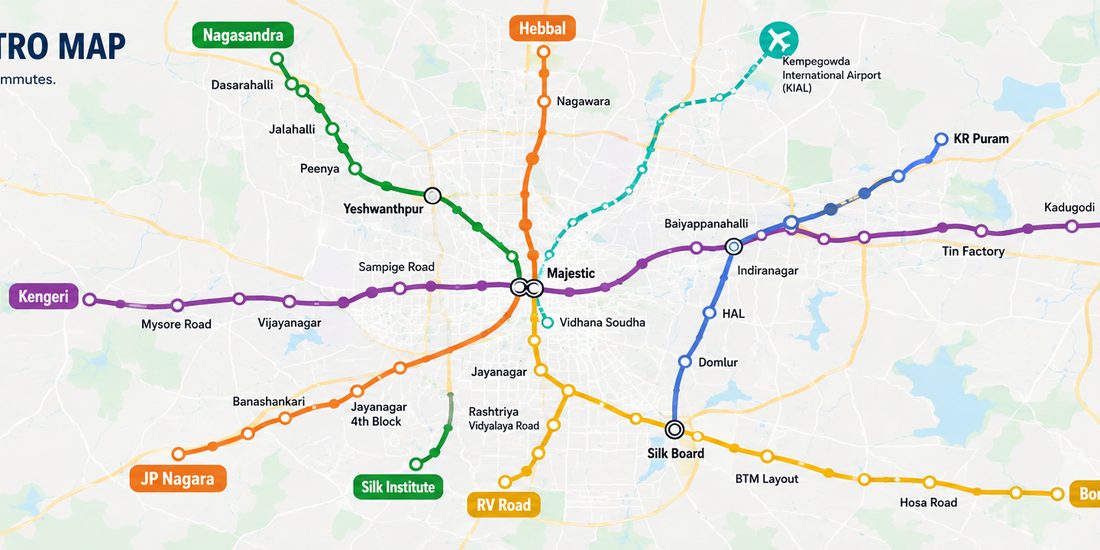
Bangalore Metro: Current and Upcoming Corridors
Phase 2A & 2B (Purple Line extension): The extension connecting Baiyappanahalli to Whitefield (and onwards to Kadugodi) is now operational. This has transformed Whitefield from a connectivity-challenged suburb into a metro-linked IT hub, with measurable impact on residential rental and resale values.
Yellow Line (RV Road to Bommasandra): When complete, this line will be a game-changer for Electronic City — currently one of the largest IT employment hubs in India but poorly served by public transport. Stations at Jayanagar, BTM Layout, Bommasandra and points along Hosur Road will make this corridor significantly more attractive to buyers who previously avoided it due to traffic concerns.
Orange Line (JP Nagara to Hebbal): This under-construction line will improve North-South connectivity through the city's western side, benefiting residents of JP Nagara, Banashankari, and Yeshwanthpur.
Blue Line (KR Puram to Silk Board): This line will serve one of Bangalore's most congested stretches. Its completion will benefit locations along Old Madras Road and around KR Puram, which is already seeing increased developer interest.
Airport Line (KIAL Terminal to Central Silk Board): An aerial metro corridor connecting Kempegowda International Airport to the city centre. Locations along this corridor — particularly near Hebbal, Yelahanka, and the airport zone — are likely to see appreciation as it progresses.
Satellite Town Ring Road (STRR)
The STRR is a proposed 280+ km expressway ring around Bangalore at a distance of approximately 25–30 km from the city centre. Its purpose is to intercept long-distance traffic before it enters the urban core, while also opening up peripheral areas for residential and industrial development. Locations that fall near proposed STRR interchanges — including areas around Devanahalli, Doddaballapur, Nelamangala, Sarjapur, and Hoskote — are attracting early-stage plotted development interest. However, these locations remain high-risk for end-user buyers until STRR timelines become more concrete.
Peripheral Ring Road (PRR)
The PRR is a closer-in orbital road planned to connect Tumkur Road, Bellary Road, Old Madras Road, Hosur Road, and Kanakapura Road. Unlike the STRR, the PRR runs through established residential corridors and will have a more immediate impact. Areas near proposed PRR alignments in South-East Bangalore (Sarjapur, Varthur, Gunjur) and North Bangalore (Yelahanka, Hebbal) stand to benefit most from reduced congestion and improved cross-city connectivity.
Which Micro-Markets Could Benefit Most?
North Bangalore (Devanahalli, Yelahanka, Hebbal): The Airport Metro line and proximity to KIAL make this corridor compelling for investors with a 5–8 year horizon. Prices are currently moderate relative to South-East Bangalore, and the aerospace and IT park developments in Devanahalli create employment depth.
East Bangalore (Whitefield, KR Puram, Kadugodi): Already benefiting from Metro Phase 2. Prices have moved but appreciation potential remains, particularly for mid-segment 2 and 3 BHK buyers who can access the area's large employment base.
South-East Bangalore (Electronic City, Bommasandra): The Yellow Line will be transformative. Pre-construction or early-stage projects in this area could see meaningful appreciation when the metro becomes operational.
West Bangalore (Mysore Road, Kengeri): Currently the most undervalued of the metro-connected corridors. The Purple Line reaches Kengeri, but employment density in the west hasn't caught up yet. Buyers with a long horizon and a tolerance for current illiquidity may find value here.
Long-Term Appreciation Potential
The historical pattern in Bangalore is clear: locations that gain metro connectivity within 3–5 years tend to see 20–35% appreciation over the infrastructure's construction and activation period. Locations on multiple corridors (metro + ring road + employment hub) tend to outperform. The most reliable appreciation story in the next 5 years is likely to be along the Yellow Line's Electronic City stretch, the Airport Line corridor around Hebbal and Yelahanka, and the PRR-adjacent parts of the Sarjapur–Varthur–Gunjur belt.