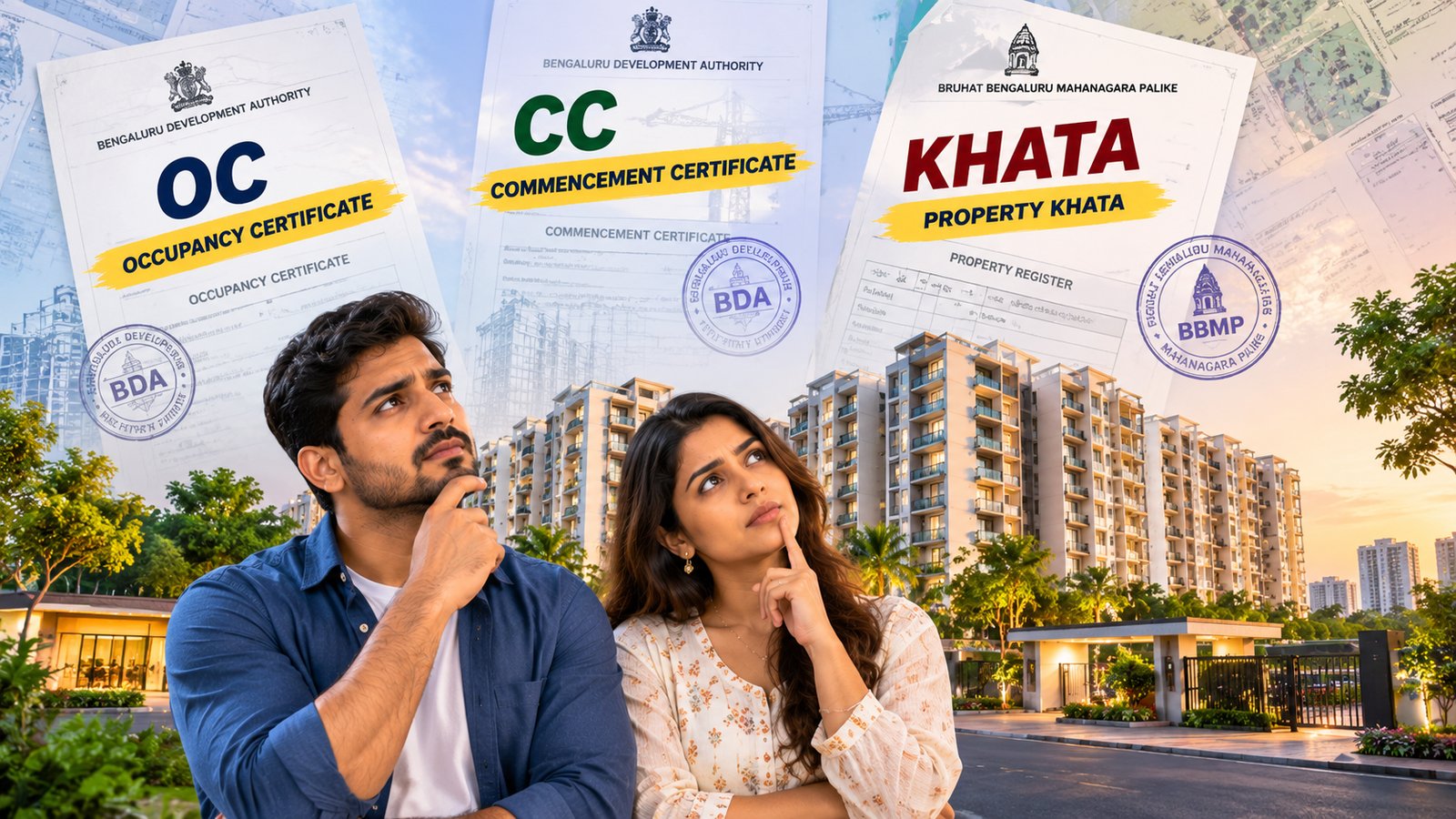
Of all the acronyms thrown around in a Bangalore property transaction, OC, CC and Khata are three that genuinely determine how legally sound your purchase is — not just paperwork formalities. This guide explains each one plainly, including the different Khata types (A, B and E) that cause the most confusion.
⚡ These three documents answer three different questions: CC asks "were you allowed to start building?", OC asks "is the finished building legally fit to occupy?", and Khata asks "is this property properly recorded for local tax and civic purposes?" All three matter, and none substitutes for another.
Commencement Certificate (CC)
The Commencement Certificate is issued by the local municipal or planning authority (BBMP, BDA, or the relevant panchayat/authority depending on location) and confirms that the builder has permission to begin construction, based on an approved building plan. Without a CC, construction is technically unauthorised from the very start — everything that follows inherits that problem.
As a buyer, the CC matters most at the booking/under-construction stage: ask to see it before you pay anything meaningful, rather than assuming that visible construction activity on site implies the builder has the right paperwork.
Occupancy Certificate (OC)
The Occupancy Certificate is issued after construction is complete, confirming the building has been built according to the sanctioned plan and is fit for people to actually live in. It's issued by the same authority that approved the plan, after inspection.
This is one of the most consequential documents in the entire purchase process, because:
- Without an OC, moving into a "ready" building is technically occupying it before it's been certified fit for occupation — a real legal exposure, even if the builder hands over keys.
- Banks are often reluctant to extend full home loan disbursement, or buyers to get certain utility connections, without an OC in place.
- Resale and future registration can be complicated for a unit that was never issued a proper OC.
Khata — What It Actually Is
Khata is a record maintained by the local civic authority (BBMP within Bangalore city limits) that identifies a specific property for property-tax assessment purposes. It is not, by itself, proof of ownership — title documents (sale deed, mother deed) establish ownership — but Khata is what lets you pay property tax properly, get certain utility connections, and, critically, apply for and register certain transactions smoothly.
A-Khata, B-Khata and E-Khata — The Difference That Actually Matters
| Khata Type | What It Means | Practical Implication |
|---|---|---|
| A-Khata | The property is fully compliant with the local authority's building bylaws and revenue regulations, and is recorded in the authority's primary (A) register with a khata certificate and extract. | Smoothest category for registration, bank loans, building plan approvals, and resale. This is what you should be aiming for, wherever possible. |
| B-Khata | A provisional or irregular record — the property is on the authority's secondary (B) register, usually because it hasn't fully complied with building regulations, the land conversion process, or other formalities (common for layouts formed before certain approvals, or where bylaw violations exist). | Property tax can still be paid, but B-Khata properties often face difficulty with full home loan approval, building plan sanction, and government scheme eligibility. Many B-Khata properties can be converted to A-Khata by regularising the underlying compliance gap — but this needs to be actively pursued, not assumed. |
| E-Khata | The newer, digitised Khata system (e-Aasthi, rolled out by BBMP) intended to eventually replace the older paper-based A/B Khata records with a unified electronic property record linked to a unique property identifier. | Over time, this is meant to simplify and standardise what used to be a confusing A/B distinction — but during the transition period, buyers should still confirm exactly which category their specific property's record falls under and whether the e-Khata migration has actually been completed for it. |
⚡ BBMP's e-Aasthi portal is the place to verify a property's current Khata status directly — don't rely solely on what a seller or builder tells you verbally.
How These Three Connect in Practice
A clean transaction typically looks like this: the builder obtained a valid CC before construction, completed the building according to the sanctioned plan, received the OC on completion, and the property carries (or is eligible to be converted to) an A-Khata. When any one of these is missing or irregular, it doesn't necessarily mean the property is unsellable or unlivable — but it does mean you're taking on specific, identifiable risk, and you should understand exactly what that risk is and factor it into your decision and price negotiation.
Questions Worth Asking Directly
- Has the OC actually been issued for this specific building/phase, or only applied for?
- What Khata category does the property currently hold, and if it's B-Khata, is there an active plan to convert it to A-Khata?
- If buying under construction, can I see the CC for the specific block/phase my unit is in?
The Bottom Line
None of these three documents is optional diligence — each answers a distinct legal question about the property you're about to commit a significant sum of money to. A B-Khata or missing OC doesn't automatically mean walk away, but it does mean you need a clear, written understanding of the gap and a realistic plan (and cost) to resolve it, before you sign.