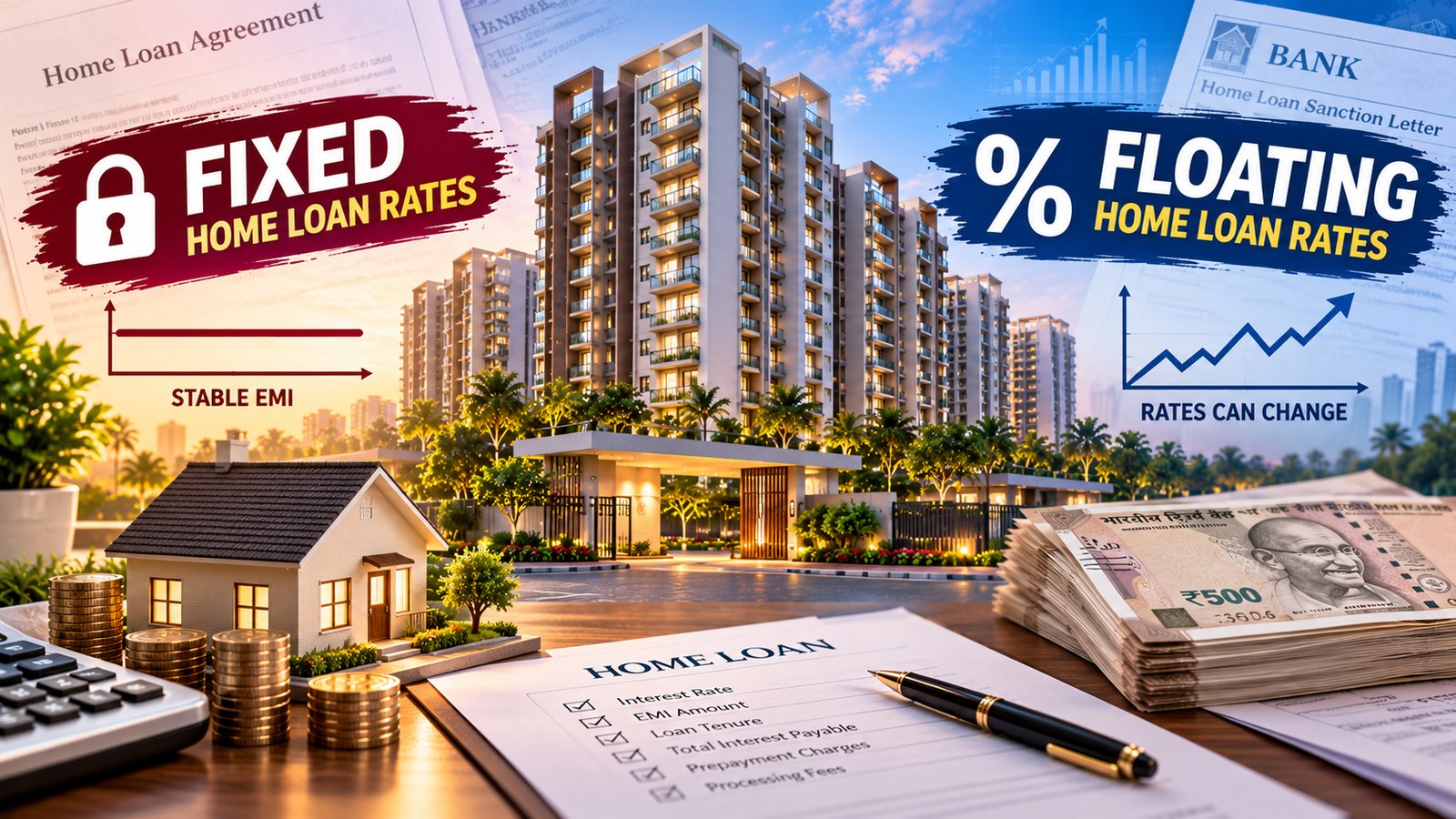
Every home loan conversation eventually arrives at this question, and most buyers answer it based on whichever rate currently looks lower — which is exactly the wrong way to decide, since today's lower rate tells you very little about your total cost over a 15–20 year loan tenure. Here's a clearer way to think about it.
⚡ This is general information to help you ask your lender the right questions — not financial advice. Loan products, spreads and current rates vary by bank and by your individual credit profile. Please verify current rates directly with lenders and consider speaking to a financial advisor for guidance specific to your situation.
What Each Term Actually Means
| Type | How the Rate Behaves | Typical Basis |
|---|---|---|
| Fixed Rate | Stays constant for a defined period (sometimes the full tenure, sometimes just the first few years before reverting to floating) | Set by the lender at disbursement, independent of RBI repo rate movements during the fixed period |
| Floating Rate | Moves up or down periodically, tracking an external benchmark | Usually linked to the RBI's repo rate via the External Benchmark Lending Rate (EBLR) framework most banks now use |
Where Rates Stand Heading Into 2027
The RBI raised the repo rate to 5.5% in October 2026, up from 5.25% — a reminder that rate direction isn't a one-way bet in either direction, even after a period of cuts. For a floating-rate borrower, a repo rate change like this typically flows through to your EMI or tenure at the next reset date specified in your loan agreement, not instantly. If you're evaluating a loan heading into 2027, ask your lender directly what their current EBLR-linked rate is and how frequently it resets, rather than relying on a headline repo-rate figure alone — spreads above the repo rate vary by lender and by your credit score and loan-to-value ratio.
The Real Trade-Off
Fixed Rate — Predictability, at a Price
A fixed rate gives you EMI certainty — useful for strict budgeting, especially early in a large loan when your monthly outgo is a significant share of income. The trade-off: fixed rates are usually set somewhat higher than the prevailing floating rate at disbursement, since the lender is pricing in the risk of rates rising during your fixed period. If rates fall after you lock in, you don't benefit until (if) your fixed period ends and you revert to or renegotiate a floating rate.
Floating Rate — Lower Starting Cost, Rate-Movement Exposure
Floating rates typically start lower than a comparable fixed rate and let you benefit automatically when the RBI cuts rates — which has happened over various periods in recent years. The trade-off is direct exposure when rates rise, as they did in October 2026: your EMI (or, depending on your lender's policy, your tenure) can increase without you doing anything.
A Simple Framework for Deciding
- If your budget has little room for an EMI increase — you're financing close to your maximum eligible amount, or your income is variable — the predictability of a fixed rate (even at a premium) may be worth more to you than the lower starting cost of a floating rate.
- If you have comfortable headroom in your monthly budget and can absorb a rate increase without real strain, a floating rate's generally lower starting cost and ability to benefit from future cuts is usually the more cost-efficient choice over a long tenure.
- If you expect to prepay or refinance within a few years regardless of rate movements, the long-run behaviour of either rate type matters less — focus on processing fees, prepayment penalties (floating-rate home loans in India generally cannot carry prepayment penalties for individual borrowers per RBI/NHB guidelines, but always confirm this with your specific lender) and how quickly you can actually prepay.
A Practical Middle Path
Some lenders offer a hybrid structure — fixed for an initial period (commonly 2–5 years) before converting to floating — which can suit buyers who want short-term predictability while they stabilise post-purchase finances, without locking into a fixed rate for the full tenure. Ask your lender directly whether this option exists and what the conversion terms are.
The Bottom Line
Neither option is universally "right" — the decision depends on your income stability, your budget headroom, and your honest expectation of how long you'll hold the loan. Get the current fixed and floating quotes from at least two or three lenders, ask about reset frequency and any switch/conversion charges, and decide based on your own cash-flow comfort rather than chasing whichever number looks lower today.